---
title: Meets or Exceeds Principle in Risk Engineering Rules
description: Learn how the Meets or Exceeds principle helps ReFocus apply agency quoting guidelines without reducing existing customer or policy values that already meet or exceed your Risk Engineering Rules.
---
[Skip to content](https://knowledge.refocusai.com/meets-or-exceeds-principle#main-content)
[More support](https://knowledge.refocusai.com/kb-tickets/new?hsLang=en) [Customer portal](https://knowledge.refocusai.com/support?hsLang=en)

- [ReFocus AI Website](https://refocusai.com)
- [Blog](https://blog.refocusai.com)
Open main navigation
Close main navigation
- [ReFocus AI Website](https://refocusai.com)
- [Blog](https://blog.refocusai.com)
- [More support](https://knowledge.refocusai.com/kb-tickets/new)
- [Customer portal](https://knowledge.refocusai.com/support)
How can we help you?
- There are no suggestions because the search field is empty.
1. [Knowledge Center](https://knowledge.refocusai.com/?hsLang=en)
2. [Onboarding](https://knowledge.refocusai.com/onboarding?hsLang=en)
3. [Risk Engineering](https://knowledge.refocusai.com/onboarding?hsLang=en#risk-engineering)
May 12, 2026
# Meets or Exceeds Principle in Risk Engineering Rules
## Learn how the Meets or Exceeds principle helps ReFocus apply agency quoting guidelines without reducing existing customer or policy values that already meet or exceed your Risk Engineering Rules.
### Overview
Risk Engineering Rules help your agency apply consistent quoting guidelines in ReFocus.
The **Meets or Exceeds** principle protects existing customer or policy information when it already meets or exceeds the value selected in a Risk Engineering Rule.
In plain English:
> If the current customer or policy information is higher than the value selected in the Risk Engineering Rule, ReFocus will keep the higher value.
This helps your agency enforce minimum standards without accidentally lowering stronger existing coverage or replacing acceptable customer-specific values.
---
### What Meets or Exceeds means
When ReFocus applies a Risk Engineering Rule, it checks whether the current value already meets or exceeds the agency’s selected rule value.
If the current value is already higher, ReFocus keeps the higher value.
#### Example
### 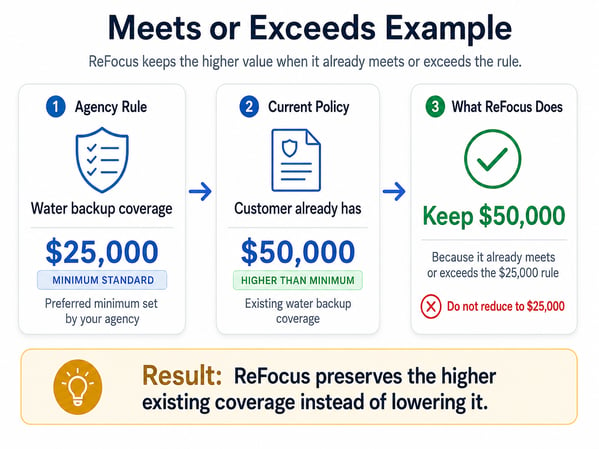
Your agency sets a Risk Engineering Rule for:
1. **Water backup coverage: $25,000**
2. If the customer’s current policy already has:
3. **Water backup coverage: $50,000**
4. ReFocus will keep the **$50,000** value because it already meets or exceeds the agency’s rule.
5. ReFocus will not reduce it to $25,000.
---
### Why ReFocus uses this principle
The Meets or Exceeds principle helps agencies apply quoting guidelines while still preserving appropriate existing coverage.
This matters because it helps your agency:
- **Enforce minimum standards** without lowering stronger existing coverage
- **Protect customer-specific values** that already meet agency guidelines
- **Set preferred minimums** while preserving better values when they already exist
- **Keep quoting workflows consistent** without removing acceptable coverage options
ReFocus is not making underwriting decisions. It is helping apply the quoting guidelines your agency configures.
---
### Example scenario
#### Liability coverage limit
Your agency rule says:
1. **Liability limit: $100,000 / $300,000**
2. If the customer’s current policy already has:
3. **$250,000 / $500,000**
4. ReFocus keeps the higher existing liability limit.
This allows your agency to set a preferred minimum while preserving stronger existing coverage.
---
### Carrier does not offer the exact coverage option
Sometimes, a carrier may not offer the exact value selected in your Risk Engineering Rule.
For example, your agency rule says:
**Liability limit: $50,000 / $100,000**
But the carrier only offers:
- $100,000 / $300,000
- $250,000 / $500,000
In this case, ReFocus will choose the next highest available option:
**$100,000 / $300,000**
This meets or exceeds the agency’s selected rule value.
---
### Deductible selection
Your agency rule says:
**Deductible: $1,000**
If the customer’s current policy already has:
**Deductible: $2,500**
ReFocus keeps the $2,500 deductible because it exceeds the selected rule value.
This is useful because carrier deductible options can vary by state, product, or carrier. If the exact deductible is not available, ReFocus can use the next-highest deductible option that meets or exceeds the rule value.
---
### How this works with Risk Engineering Rules
Risk Engineering Rules are used to guide how ReFocus completes quoting or renewal workflows based on your agency’s preferences.
The Meets or Exceeds principle applies when:
- A current customer or policy value already exists
- That value is higher than the value selected in the Risk Engineering Rule
- A carrier does not offer the exact selected value, but offers a higher available option
In these cases, ReFocus preserves or selects the value that meets or exceeds the rule rather than reducing the value to the rule amount.
---
### Best practices
**Use rules as preferred minimums**
Set Risk Engineering Rules based on the values your agency generally wants ReFocus to use when quoting.
For many coverage limits, the rule should represent the minimum acceptable value your agency wants to apply.
**Review carrier-specific options**
Carrier options can vary by state, line of business, or product.
If the exact value selected in a rule is not offered by a carrier, ReFocus may use the next highest available option that meets or exceeds the rule value.
**Be thoughtful with deductibles**
Deductibles can work differently from coverage limits because a higher deductible is not always better for every customer.
Use deductible rules when your agency has a clear preference for how deductible values should be handled.
**Use the overwrite checkbox intentionally**
The overwrite checkbox should be used when your agency wants ReFocus to replace existing information based on the rule setup.
The Meets or Exceeds principle still helps protect higher values from being reduced when they already satisfy the rule.
---
### Quick reference table
| Scenario | Example | What ReFocus does |
| --- | --- | --- |
| Current value is lower than the rule | Rule is $25,000; current value is $10,000 | ReFocus may apply the rule value |
| Current value matches the rule | Rule is $25,000; current value is $25,000 | ReFocus keeps the current value |
| Current value is higher than the rule | Rule is $25,000; current value is $50,000 | ReFocus keeps the higher value |
| Exact carrier option is not available | Rule is $50,000 / $100,000; carrier offers $100,000 / $300,000 | ReFocus selects the next highest available option |
| Deductible option varies by carrier or state | Rule is $1,000; carrier offers $1,500 | ReFocus may select the next highest available deductible |
#### Rule of thumb
If the current customer or policy value already **meets or exceeds** the Risk Engineering Rule, ReFocus keeps the higher value.
If the exact rule value is not available from a carrier, ReFocus uses the next highest available option that meets or exceeds the agency’s selected value.
---
### Related articles
For more detailed guidance, see separate articles on:
- [**Using Default, Rules, and Nested Risk Engineering Rules**](https://knowledge.refocusai.com/risk-engineering?hsLang=en)
- [**How to Override or Respect Existing Information in Risk Engineering Rules**](https://knowledge.refocusai.com/override-risk-engineering-rules?hsLang=en)
- [**Presets available for Risk Engineering when onboarding**](https://knowledge.refocusai.com/preset-risk-engineering-values?hsLang=en)
- [Onboarding](https://knowledge.refocusai.com/onboarding?hsLang=en#main-content)
- [Start Here](https://knowledge.refocusai.com/onboarding?hsLang=en#start-here)
- [Set up Carrier Access & MFA Forwarding](https://knowledge.refocusai.com/onboarding?hsLang=en#set-up-carrier-access-mfa-forwarding)
- [Account Monitoring](https://knowledge.refocusai.com/onboarding?hsLang=en#account-monitoring)
- [Remarketing](https://knowledge.refocusai.com/onboarding?hsLang=en#remarketing)
- [Data Enrichment](https://knowledge.refocusai.com/onboarding?hsLang=en#data-enrichment)
- [Risk Engineering](https://knowledge.refocusai.com/onboarding?hsLang=en#risk-engineering)
- [Installing & Using Bridge (Browser Extension)](https://knowledge.refocusai.com/onboarding?hsLang=en#installing-using-bridge-browser-extension)
- [Renewal Hub](https://knowledge.refocusai.com/onboarding?hsLang=en#renewal-hub)
- [User Access and Permissions](https://knowledge.refocusai.com/onboarding?hsLang=en#user-access-and-permissions)
- [Integrations](https://knowledge.refocusai.com/integrations?hsLang=en#main-content)
- [General](https://knowledge.refocusai.com/integrations?hsLang=en#general)
- [Jetfile](https://knowledge.refocusai.com/integrations?hsLang=en#jetfile)
- [AgencyZoom](https://knowledge.refocusai.com/integrations?hsLang=en#agencyzoom)
- [AMS360](https://knowledge.refocusai.com/integrations?hsLang=en#ams360)
- [EZLynx](https://knowledge.refocusai.com/integrations?hsLang=en#ezlynx)
- [Hawksoft](https://knowledge.refocusai.com/integrations?hsLang=en#hawksoft)
- [Salesforce](https://knowledge.refocusai.com/integrations?hsLang=en#salesforce)
- [Applied Epic](https://knowledge.refocusai.com/integrations?hsLang=en#applied-epic)
- [QQ Catalyst](https://knowledge.refocusai.com/integrations?hsLang=en#qq-catalyst)
- [MomentumAMP](https://knowledge.refocusai.com/integrations?hsLang=en#momentumamp)
- [Best Practices Guide](https://knowledge.refocusai.com/best-practices-guide?hsLang=en)
- [Release Notes](https://knowledge.refocusai.com/release-notes?hsLang=en#main-content)
- [2025](https://knowledge.refocusai.com/release-notes?hsLang=en#2025)
- [2026](https://knowledge.refocusai.com/release-notes?hsLang=en#2026)
- [Product Roadmap](https://knowledge.refocusai.com/release-notes?hsLang=en#product-roadmap)
[](http://refocusai.com)
[mailto:support@refocusai.com](mailto:support@refocusai.com)
Copyright © 2025, ReFocus AI Inc.